15 Best Coconut Oil Brands for Cooking Delicious Meals in 2026
by Touseef Shaikh
Which coconut oil should you actually cook with in 2026 — and does the brand even matter? Short answer: yes, it absolutely does. From smoke point to flavor profile to how the oil is extracted, the differences between brands can significantly affect both your food and your health. If you're leaning toward a premium cold-pressed option, Nutiva Organic Virgin Coconut Oil is the one to beat — but keep reading, because the right pick depends entirely on how you cook.
Coconut oil has earned its place in kitchens worldwide, and for good reason. According to Wikipedia's overview of coconut oil, it's composed largely of saturated fatty acids — primarily lauric acid — and medium chain triglycerides (MCTs) that the body metabolizes differently than long-chain fats. That's part of why it's become a staple in paleo, keto, and whole-food diets. But not all coconut oils are created equal. Refined, unrefined, cold-pressed, liquid — there's a lot to unpack before you buy.
In this guide, we've reviewed 15 of the top coconut oil brands for 2026, narrowed down to the 7 most widely available and consistently well-reviewed options on Amazon. Whether you're sautéing vegetables, baking vegan brownies, or looking for a neutral high-heat oil to replace vegetable oil, there's a coconut oil here that fits your kitchen. Browse all our grocery product reviews for more buying guides like this one.

Contents
- Editor's Recommendation: Top Picks of 2026
- Full Product Breakdowns
- Nutiva Organic Virgin Coconut Oil — Best Overall
- Viva Naturals Organic Coconut Oil — Best Cold-Pressed
- Kirkland Signature Virgin Coconut Oil — Best Bulk Value
- Carrington Farms Liquid Coconut Oil — Best Neutral Flavor
- BetterBody Foods Refined Coconut Oil — Best for High Heat
- Dr. Bronner's Organic Virgin Coconut Oil — Best Fair Trade
- LouAna Pure Coconut Oil — Best Budget Pick
- What to Look For When Buying Coconut Oil
- Questions Answered
- Next Steps
Editor's Recommendation: Top Picks of 2026
- #PreviewProductRating
- Bestseller No. 1
 Rating:

- Bestseller No. 2
 Rating:
 - Bestseller No. 3
 Rating:
 - Bestseller No. 4
 Rating:
 - Bestseller No. 5
 Rating:
 - Bestseller No. 6
 Rating:
 - Bestseller No. 7
 Rating:

Full Product Breakdowns
1. Nutiva Organic, Cold-Pressed, Unrefined, Virgin Coconut Oil — Best Overall
Nutiva is one of the most recognized names in organic coconut oil, and the 15-ounce virgin variety has earned that reputation honestly. Cold-pressed and completely unrefined, this oil is extracted without chemicals, hexane, or heat — which means the nutrients and natural flavor stay intact. You get a noticeably fresh coconut aroma and a light, clean taste that works particularly well in recipes where a subtle coconut note is welcome: think stir-fries, oatmeal, and tropical-style baked goods.
On the nutritional side, Nutiva's process yields an oil with 63% medium chain triglycerides and 50% lauric acid. Those are solid numbers for anyone tracking their MCT intake or following a ketogenic or paleo diet. The oil is also certified USDA Organic and non-GMO. Beyond the kitchen, it doubles as a body moisturizer and hair conditioner — a bonus if you like multi-purpose pantry staples.
The 15-ounce size is practical for most households, though if you cook with it daily you'll go through it quickly. At room temperature the oil is solid and white; above 76°F it melts into a clear liquid. That's completely normal and doesn't affect quality. The jar is easy to scoop from and seals well between uses.
Pros:
- Cold-pressed with no chemicals or hexane — nutrients fully preserved
- 63% MCTs and 50% lauric acid — strong nutritional profile
- Works for cooking, baking, skin care, and hair care
- USDA Organic and non-GMO certified
- Compatible with keto, paleo, vegan, and gluten-free diets
Cons:
- Distinct coconut flavor — not ideal for savory dishes where you want neutral oil
- 15-oz jar runs out fast for heavy daily use

2. Viva Naturals Organic Coconut Oil — Best Cold-Pressed for Multipurpose Use
Viva Naturals positions itself as the all-in-one coconut oil — equally at home in your frying pan, your hair, and your skincare routine. The 16-ounce jar is cold-pressed from fresh organic coconuts and carries both USDA Organic and Non-GMO Project Verified certifications. What sets Viva Naturals apart is its smoke point transparency: rated at 350°F, it's clearly suited for baking, sautéing, and light frying rather than high-heat applications.
The flavor is rich and aromatic — you'll notice the coconut character in your food. That's a good thing when you're baking tropical muffins or making a coconut curry; it's less ideal for a recipe that needs a neutral fat. The texture is smooth and scoopable at room temperature. Reviewers frequently mention the fresh, clean smell as a standout quality.
For beauty use, the natural fat profile makes it an effective conditioner for dry or curly hair, and it removes makeup cleanly without irritation. The 16-oz size is a sweet spot — enough to use freely for both kitchen and personal care without running out weekly. This is a solid pick if you want one product that does it all.
Pros:
- USDA Organic + Non-GMO Project Verified — credentialed and trustworthy
- Works for cooking, baking, hair conditioning, and makeup removal
- Rich coconut aroma and flavor — excellent for tropical recipes
- Smoke point clearly stated at 350°F — honest marketing
- 16-oz jar is a practical size for most households
Cons:
- Strong coconut flavor limits use in savory or neutral-flavored dishes
- 350°F smoke point rules it out for deep frying
3. Kirkland Signature Cold Pressed Unrefined Organic Virgin Coconut Oil — Best Bulk Value
If you use coconut oil regularly and hate running out, Kirkland Signature's 84-ounce two-pack is a serious option. This is Costco's own brand, and it delivers on the fundamentals: cold-pressed, unrefined, and certified USDA Organic by OneCert — all without the premium price tag of boutique brands. At this volume, the per-ounce cost is significantly lower than buying smaller jars, which adds up quickly if coconut oil is a kitchen staple for you.
The quality is consistent and comparable to name brands. The oil is chemical-free, has a natural coconut aroma, and behaves exactly as you'd expect a virgin coconut oil to behave — solid below 76°F, clear liquid above it. It works as a butter substitute in baking, a base for sautéing vegetables, and a spread for toast or oatmeal. Kirkland keeps things simple: no fancy claims, no added ingredients, just a clean unrefined product.
The main consideration is storage. Two 84-ounce jars take up real pantry space, and once opened, you want to make sure you're going through it within a reasonable timeframe — typically 12–24 months for unrefined coconut oil. If you bake frequently, make vegan flour-based recipes that call for coconut oil, or cook for a large household, this bulk pack makes a lot of sense.
Pros:
- Excellent value per ounce — bulk pricing beats most single jars
- USDA Organic certified, cold-pressed, and chemical-free
- Clean virgin coconut flavor consistent batch to batch
- Works as a butter substitute in baking
Cons:
- Large size requires significant pantry space
- Only practical if you use coconut oil regularly enough to finish it
- Less convenient for one-person households or occasional users
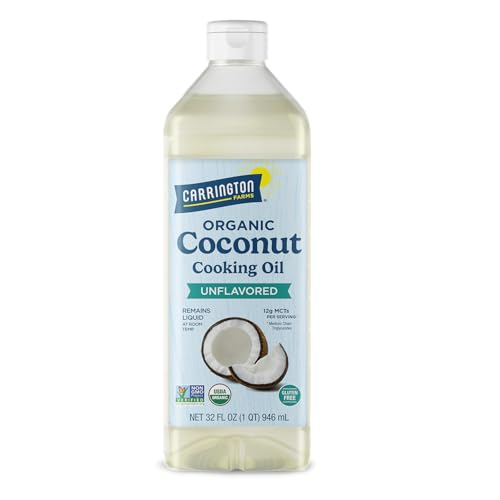
4. Carrington Farms Organic Liquid Coconut Cooking Oil — Best Neutral Flavor, Stays Liquid
Carrington Farms takes a different approach from the rest of the lineup: their coconut oil is liquid at room temperature and completely unflavored. If you've ever wanted the health benefits of coconut oil without the coconut taste or the solid-to-liquid phase change drama, this is the product designed specifically for you. The 32-ounce bottle pours like any standard cooking oil — no melting required, no scooping solid oil from a jar.
The neutral flavor means you can use it anywhere you'd normally reach for vegetable oil, canola, or corn oil. Sauté onions, fry eggs, dress salads, bake cakes — none of your food will taste like coconut. It's Non-GMO Project Verified, hexane-free, gluten-free, and contains no trans fats or hydrogenated fats. The BPA-free bottle is a practical touch for food safety. Carrington also claims it contains 5x more MCTs than standard virgin coconut oil, which is a notable selling point for keto or MCT-focused dieters.
One thing to understand: this product achieves its liquid state by removing the longer-chain fatty acids (including some lauric acid), which is why it loses the coconut flavor. It's technically a fractionated coconut oil, not a traditional virgin variety. That's neither good nor bad — it just means the product is optimized for convenience and neutrality rather than the full coconut oil nutrient profile. Check how it compares to other high-smoke-point oils for cooking if frying is your primary use case.
Pros:
- Stays liquid at room temperature — no phase change, easy to pour
- Completely neutral taste and smell — works in any recipe
- Non-GMO, hexane-free, gluten-free, no trans fats
- High MCT concentration — marketed as 5x that of standard virgin coconut oil
- BPA-free bottle with pour spout — very practical
Cons:
- Fractionated — doesn't have the full fatty acid profile of virgin coconut oil
- Missing the coconut flavor some users specifically want
- Higher price per ounce than some virgin alternatives
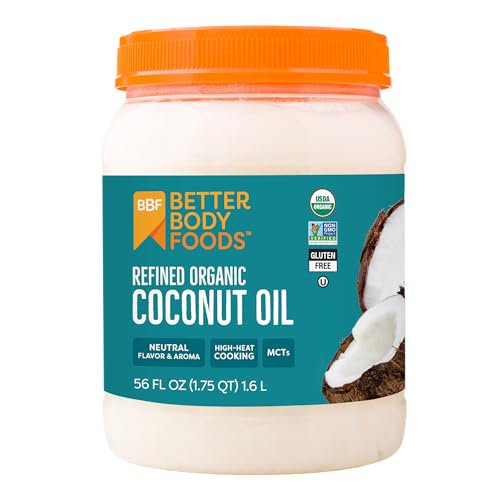
5. BetterBody Foods Organic Refined Coconut Oil — Best for High-Heat Cooking
BetterBody Foods' refined coconut oil solves two problems at once: the coconut flavor you might not always want, and the smoke point limitation that holds back most virgin oils. With a smoke point of 425°F, this refined oil can handle high-heat sautéing, stir-frying, and even deep frying without breaking down. That's a major advantage over unrefined coconut oils, which typically max out around 350°F.
The refining process removes the coconut scent and taste entirely, making this a true neutral cooking fat. You won't taste coconut in your scrambled eggs, steak, or roasted vegetables. BetterBody says you can substitute it one-to-one for butter, margarine, shortening, or standard vegetable oils — and in practice, that works well. The 56-ounce size is substantial and cost-effective, particularly for households that cook frequently.
On the nutrition side, the oil still contains roughly 60% MCTs even after refining, which is a solid retention of the functional fats. It's USDA Organic certified, which is worth noting since many refined coconut oils lose their organic status through processing. The trade-off with refining is always the same: you gain smoke point and neutrality, but you lose some of the micronutrients and antioxidants present in raw cold-pressed oil. For everyday high-heat cooking, though, this is a very capable option.
Pros:
- 425°F smoke point — handles high-heat cooking without issue
- Completely neutral flavor — works in any dish
- USDA Organic certified even after refining — rare
- ~60% MCTs retained — solid nutritional profile
- Large 56-oz size offers good value
Cons:
- Refining removes some natural antioxidants and nutrients
- No coconut aroma or flavor — not for recipes where that's desired
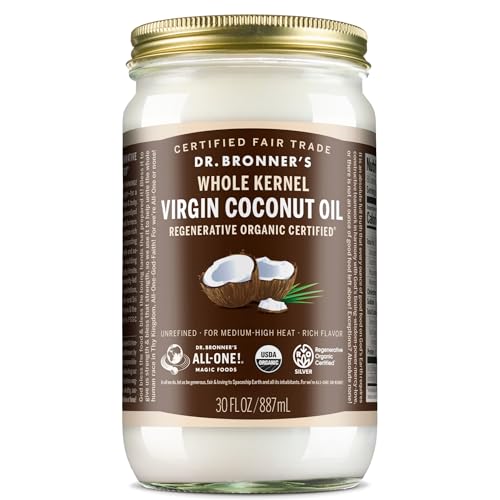
6. Dr. Bronner's Organic Virgin Coconut Oil — Best Fair Trade and Ethically Sourced
Dr. Bronner's is best known for its soap, but the brand's coconut oil has quietly built a loyal following among buyers who care where their food comes from. This is a 30-ounce whole-kernel coconut oil that's expeller-pressed, Regenerative Organic Certified, and Fair Trade — not just buzzwords, but verified certifications that track back to the brand's own sister company in Sri Lanka. One ingredient. Full stop.
The whole-kernel pressing method uses the entire dried coconut rather than just the coconut meat, which gives the oil a distinctly rich, nutty flavor — noticeably different from oils pressed from fresh coconut. Some cooks specifically seek out that deeper, toastier coconut character for certain dishes. It's excellent in stir-fries, curries, and baking applications where a more pronounced coconut note is an asset.
Beyond the kitchen, Dr. Bronner's promotes this oil for hair and body care, oil pulling, and oral health. The regenerative organic farming practices the brand uses in Sri Lanka are designed to enrich soil and promote biodiversity — if sustainability is part of your purchasing criteria, this oil is worth the premium. The 30-oz jar is generous and sits at a mid-range price point for a quality virgin oil.
Pros:
- Regenerative Organic Certified + Fair Trade — highest ethical sourcing standards
- Whole-kernel pressing yields a rich, nutty flavor depth
- Single ingredient — 100% coconut oil, nothing else
- Versatile: cooking, baking, hair, skin, oil pulling
- Climate-friendly farming practices in Sri Lanka
Cons:
- Stronger, nuttier flavor may not suit all recipes
- Premium price point compared to mass-market brands
- Whole-kernel flavor is different from standard virgin — takes some adjustment
7. LouAna Pure Coconut Oil — Best Budget-Friendly Kitchen Staple
LouAna isn't trying to win any awards for certifications or sourcing storytelling. What it offers is simple: 30 fluid ounces of pure coconut oil at a price point that undercuts nearly every other brand on this list. For budget-conscious cooks who just need a reliable cooking fat, LouAna gets the job done without complications.
This is a refined coconut oil, which means it has a neutral flavor and a higher smoke point than virgin varieties — suitable for pan-frying, roasting, and baking without imparting any coconut taste. It's advertised as "all natural" and contains no artificial additives, though it doesn't carry USDA Organic certification. If organic certification is a priority for you, this isn't your oil. If you're cooking family dinners on a budget and want a versatile, easy-to-use fat in a large bottle, LouAna is worth knowing about.
The 30-ounce size is practical, the bottle is straightforward, and there's nothing tricky about using it. Swap it one-to-one for vegetable oil in most recipes. It won't bring any special flavor or functional food credentials to the table, but it will keep your food from sticking to the pan and serve as a dependable everyday oil.
Pros:
- Very affordable — lowest price per ounce on this list
- Neutral flavor — works in any savory or sweet recipe
- Higher smoke point from refining — versatile for most cooking methods
- 30-oz size is practical for regular use
- No artificial additives
Cons:
- Not USDA Organic certified
- No cold-pressed or non-GMO verification
- Minimal nutritional claims — no MCT content data provided
- Not suitable for raw or whole-food purists
What to Look For When Buying Coconut Oil
Refined vs. Unrefined: Know Which One You Need
This is the most important decision you'll make when buying coconut oil. Here's the quick breakdown:
- Unrefined (virgin or extra-virgin): Cold-pressed from fresh coconut, retains natural flavor, aroma, and micronutrients. Smoke point around 350°F. Best for medium-heat cooking, raw applications, and when you want the coconut taste.
- Refined: Processed to remove flavor and raise the smoke point (typically 400–425°F). Better for high-heat cooking and neutral-tasting dishes. Fewer antioxidants, but still rich in MCTs.
If you're using coconut oil in a curry or tropical smoothie bowl, go unrefined. If you're searing chicken or stir-frying at high heat, refined is the smarter call.
Smoke Point Matters More Than You Think
Cooking any oil past its smoke point degrades the fat, produces harmful compounds, and makes your food taste burned. Most virgin coconut oils have a smoke point around 350°F — perfectly fine for baking, sautéing at medium heat, and light frying. If you routinely cook at higher temperatures, a refined coconut oil with a 400°F+ smoke point is the safer choice. This is the same reason some cooks prefer avocado oil or ghee for very high-heat applications.
Certifications and Sourcing
Not all certifications are equal, but a few are worth looking for:
- USDA Organic: Verifies the coconuts were grown without synthetic pesticides or fertilizers.
- Non-GMO Project Verified: Third-party verification that no genetically modified ingredients are present.
- Fair Trade: Ensures farmers received fair compensation — relevant for brands like Dr. Bronner's that emphasize supply chain ethics.
- Cold-Pressed: Not a formal certification, but indicates a gentler extraction method that preserves more nutrients.
If budget is tight, organic certification is more important than fair trade for most buyers. If ethics and sustainability matter to you, look for brands that carry both.
Size, Format, and Practical Storage
Coconut oil's shelf life is long — typically 1–2 years — so buying in bulk is a reasonable strategy if you use it frequently. A few practical notes:
- Standard jarred coconut oil is solid below 76°F and liquid above it — store at room temperature and expect it to change state with the seasons.
- Liquid coconut oil (like Carrington Farms) is fractionated and stays pourable year-round — convenient but with a modified fat profile.
- Large tubs (Kirkland's 84-oz two-pack) are great value but require storage space. Make sure you'll use it before it expires.
- Once opened, keep the lid tight and a clean spoon nearby to avoid contamination.
Questions Answered
What's the difference between refined and unrefined coconut oil for cooking?
Refined coconut oil has been processed to remove its coconut flavor and raise its smoke point — typically to around 400–425°F. Unrefined (virgin) coconut oil is cold-pressed with minimal processing, retaining the natural coconut taste and aroma, but with a lower smoke point of around 350°F. For high-heat cooking, refined is better. For raw applications, baking, or when you want coconut flavor, go unrefined.
What is the smoke point of coconut oil and why does it matter?
The smoke point is the temperature at which an oil begins to break down and smoke. Most virgin coconut oils smoke at around 350°F. Refined versions can handle 400–425°F. Cooking beyond the smoke point degrades the oil's fatty acids, produces potentially harmful compounds, and imparts a burnt flavor to your food. Match the oil you choose to the heat level you actually cook at.
Is coconut oil actually healthy to cook with in 2026?
Coconut oil is high in saturated fat, which has been debated in nutrition science for decades. Current consensus is that it's fine in moderation as part of a varied diet — particularly because its MCTs (medium chain triglycerides) are metabolized differently than long-chain saturated fats. It's a staple in keto, paleo, and whole-food diets. That said, it's still a calorie-dense fat, so portion size matters just like with any cooking oil.
Can I substitute coconut oil for butter in baking?
Yes — coconut oil is one of the most practical butter substitutes in baking. Use a 1:1 ratio when the butter is melted; if the recipe calls for softened or solid butter, slightly less coconut oil (about ¾ the amount) often works better. Virgin coconut oil will add a mild coconut note to baked goods; refined coconut oil will be completely neutral. It works especially well in cookies, quick breads, muffins, and brownies.
What does "cold-pressed" mean on a coconut oil label?
Cold-pressing is an extraction method that presses the coconut meat at low temperatures (typically below 120°F) without applying heat or chemicals. This preserves more of the oil's natural antioxidants, vitamins, and fatty acids compared to methods that use heat or solvents. It's generally considered the highest-quality extraction method for virgin coconut oil, though it also tends to be more expensive.
How should I store coconut oil to keep it fresh?
Store coconut oil in a cool, dry place away from direct sunlight — a pantry or kitchen cabinet works well. You don't need to refrigerate it; in fact, refrigeration makes it very hard and difficult to scoop. At room temperature, it will be solid in cooler months and liquid in warmer months — both states are perfectly normal and don't affect quality. Shelf life is typically 12–24 months for virgin oils; keep the lid sealed tightly between uses.
Buy on Walmart
- Nutiva Organic, Cold-Pressed, Unrefined, Virgin Coconut Oil — Walmart Link
- Viva Naturals Organic Coconut Oil, 16 fl oz – Unrefined, Col — Walmart Link
- Kirkland Signature Cold Pressed Unrefined Organic Virgin Coc — Walmart Link
- Carrington Farms Organic Liquid Coconut Cooking Oil, 32 Fl O — Walmart Link
- BetterBody Foods Organic Refined Coconut Oil, 56 Fl Oz, All — Walmart Link
- Dr. Bronner's - Organic Virgin Coconut Oil (Whole Kernel, 30 — Walmart Link
- LouAna Pure Coconut Oil (All Natural) 30 fl oz — Walmart Link
Buy on eBay
- Nutiva Organic, Cold-Pressed, Unrefined, Virgin Coconut Oil — eBay Link
- Viva Naturals Organic Coconut Oil, 16 fl oz – Unrefined, Col — eBay Link
- Kirkland Signature Cold Pressed Unrefined Organic Virgin Coc — eBay Link
- Carrington Farms Organic Liquid Coconut Cooking Oil, 32 Fl O — eBay Link
- BetterBody Foods Organic Refined Coconut Oil, 56 Fl Oz, All — eBay Link
- Dr. Bronner's - Organic Virgin Coconut Oil (Whole Kernel, 30 — eBay Link
- LouAna Pure Coconut Oil (All Natural) 30 fl oz — eBay Link
Next Steps
- Decide whether you need refined or unrefined coconut oil based on your most common cooking temperature — then filter your options to just those two or three that match.
- Check current prices on Amazon for your top pick, since coconut oil pricing fluctuates frequently and the bulk options especially vary in value month to month.
- If you're switching from another cooking oil, try your chosen coconut oil in one recipe first — a simple sauté or batch of baked goods — before committing to a large size.
- Browse more pantry essentials in our grocery product reviews section, including our guide to the best balsamic vinegars for salads if you're building out a complete cooking oil and condiment pantry.
- If you're pairing coconut oil with a whole-food or paleo eating plan, check out our roundup of the best healthy granola cereals for more clean-ingredient pantry staples that fit the same lifestyle.


About Touseef Shaikh
Touseef Shaikh is a food writer and grocery researcher with years of experience evaluating grocery products for nutritional quality, ingredient transparency, and everyday value. His research-driven approach to food product reviews covers pantry staples, snacks, beverages, fresh produce, and organic alternatives — with a focus on helping shoppers make better decisions at the grocery store without spending more than they need to. At GroceriesReview, he covers food and grocery product reviews, buying guides, and meal planning resources.
You can get FREE Gifts. Or latest Free phones here.
Disable Ad block to reveal all the info. Once done, hit a button below