9 Best Truffle Oil Brands for Great Aroma in Your Favorite Recipes
by Touseef Shaikh
Fresh white truffles can fetch more than $3,000 per pound at peak season — which is exactly why truffle oil exists. It delivers that unmistakable earthy, musky aroma at a fraction of the cost, making gourmet-level cooking accessible for everyday home kitchens. Whether you're finishing a bowl of pasta, elevating popcorn, or drizzling over scrambled eggs, the right truffle oil can transform a simple dish into something genuinely special.
The truffle oil market has grown considerably, and in 2026 you have more options than ever — from artisan Italian imports to trendy lifestyle brands. Not all truffle oils are created equal, though. Some use real truffle pieces; others rely on synthetic 2,4-dithiapentane to mimic the aroma. Knowing what to look for saves you money and disappointment. If you're also exploring other quality finishing oils, our guide to the best oils for frying fish covers how different oils perform under heat.
In this review we've tested and researched nine standout brands — covering white and black truffle varieties, different price points, and bottle sizes — so you can find the one that fits your cooking style. We've also included a quick buying guide at the end to help you understand exactly what separates a great truffle oil from a mediocre one. For more specialty pantry picks, browse our full product reviews section.

Contents
- Our Top Picks for 2026
- Detailed Product Reviews
- La Tourangelle White Truffle Oil — Best for Drizzling & Finishing
- Urbani White Truffle Oil — Best Authentic Italian
- TRUFF White Truffle Oil — Best for Delicate Dishes
- TRUFF Black Truffle Oil — Best Premium Black Truffle
- DeLallo Truffle Oil — Best Value 3-Pack
- TruffleHunter Black Truffle Oil — Best Everyday Black Truffle
- La Rustichella White Truffle Olive Oil — Best Large Bottle
- Key Features to Consider When Choosing
- Common Questions
- Key Takeaways
Our Top Picks for 2026
- #PreviewProductRating
- Bestseller No. 1
 Rating:

- Bestseller No. 2
 Rating:
 - Bestseller No. 3
 Rating:
 - Bestseller No. 4
 Rating:
 - Bestseller No. 5
 Rating:
 - Bestseller No. 6
 Rating:
 - Bestseller No. 7
 Rating:

Detailed Product Reviews
1. La Tourangelle White Truffle Oil — Best for Drizzling & Finishing
La Tourangelle has built a strong reputation in the artisan oil space, and their White Truffle Infused Oil lives up to that name. The flavor profile pulls from the Italian White Alba Truffle, delivering layered notes of woods, earth, and a subtle fruit character that lingers on the palate. At 8.45 fl oz, it's sized right for home use without feeling wasteful.
What sets this oil apart from many competitors is the intentional restraint in the aroma — it's bold enough to make an impact but never crosses into synthetic territory. Drizzle it over fresh pasta, roasted potatoes, or even a basic bowl of popcorn and you'll understand why this brand has such a loyal following. The bottle design is also clean and practical, making it easy to control your pour.
It works equally well for professional chefs looking for a consistent finishing oil and for home cooks experimenting with elevated weeknight meals. The versatility here is real — this isn't a one-trick pantry item.
Pros:
- Complex, layered flavor inspired by authentic White Alba Truffle
- Works across a wide range of dishes — pasta, salads, meats, popcorn
- Artisanal quality from a well-established, trusted brand
- Restrained aroma that doesn't overwhelm delicate dishes
Cons:
- 8.45 oz may run out quickly for frequent users
- Infused rather than made with fresh whole truffles

2. Urbani White Truffle Oil — Best Authentic Italian
Urbani is one of the oldest and most respected truffle houses in Italy — the company has been sourcing and selling truffles since 1852. Their White Truffle Oil brings that heritage directly to your kitchen. Olive oil infused with authentic Italian white truffles gives this a provenance that many American-branded alternatives simply can't match. It's all-natural and vegan, which matters to a growing number of shoppers.
You'll notice the aroma immediately when you open the bottle. It's earthy, aromatic, and genuinely reminiscent of fresh truffles rather than the harsh chemical punch you sometimes get with budget brands. Use it over pasta, drizzle it on pizza, or fold it into risotto during plating — it elevates each application cleanly. The 8.45 fl oz size is consistent with most premium truffle oils on the market.
For those who care about sourcing and tradition, Urbani is hard to beat. If you're building a pantry of quality finishing oils — similar to how you might curate your balsamic vinegar selection — this one earns a permanent spot.
Pros:
- Backed by nearly 175 years of Italian truffle expertise
- Authentic Italian white truffles used in infusion
- All-natural and vegan formulation
- Excellent over pasta, fish, grilled meats, and crostini
Cons:
- Premium brand name can mean a premium price tag
- Flavor may be subtler than some expect from a white truffle oil
3. TRUFF White Truffle Oil — Best for Delicate Dishes
TRUFF built its brand identity around bold, luxury-positioned hot sauces and pasta sauces — but their truffle oils stand on their own. The White Truffle Oil uses a neutral-flavored olive oil base specifically chosen to let the truffle shine, rather than competing with a robust EVOO character. The result is a brighter, more floral finishing oil compared to the earthier black variety.
At 5.6 fl oz, the bottle is smaller than some competitors, but the concentration is solid. This is a drizzling oil, not a cooking oil — a few drops go a long way. TRUFF's white version pairs best with lighter dishes: white pizza, delicate fish, fresh salads, and soft-scrambled eggs. It's non-GMO, gluten-free, and free of artificial flavors, sodium, sugar, and cholesterol.
The packaging is sleek and gift-friendly, which makes this a popular choice for food enthusiasts looking for something that looks as good on the counter as it tastes on the plate. If you already use TRUFF's black truffle oil, having both in rotation lets you match the right variety to each dish.
Pros:
- Brighter, more floral profile than black truffle oil — great for delicate foods
- Non-GMO, gluten-free, no artificial flavors
- Neutral olive oil base keeps truffle flavor front and center
- Premium packaging that makes it an excellent gift
Cons:
- 5.6 fl oz bottle is smaller than most competitors
- Higher price per ounce compared to traditional Italian brands
4. TRUFF Black Truffle Oil — Best Premium Black Truffle
TRUFF's Black Truffle Oil is the product that finally lets the truffle take center stage after years of being a supporting ingredient in their sauces. It's a blend of real black winter truffle and neutral-flavored olive oil with no artificial flavors — what you get is pure truffle character, full stop. The earthy, robust, and slightly funky aroma of black winter truffle is distinctive, and TRUFF captures it well.
This oil is the bolder of the two TRUFF varieties. It pairs best with rich, hearty foods: red meats, tomato-based pastas, roasted mushrooms, and even drizzled over fries or popcorn. A few drops before serving is all it takes. Like the white version, it's all-natural, non-GMO, and free of gluten, sodium, sugar, and cholesterol.
The 5.6 fl oz bottle has the same premium presentation as the white. If you're deciding between white and black, think about what you cook most. Bold, meat-forward dishes go with black; lighter, more delicate plates go with white. Many truffle oil enthusiasts keep both.
Pros:
- Real black winter truffle used in the infusion — no artificial flavors
- Bold, earthy flavor profile ideal for red meats and robust pastas
- All-natural, non-GMO, gluten-free
- Sleek, gift-worthy packaging
Cons:
- Small 5.6 oz bottle disappears quickly if you use truffle oil regularly
- Among the more expensive options per ounce on this list
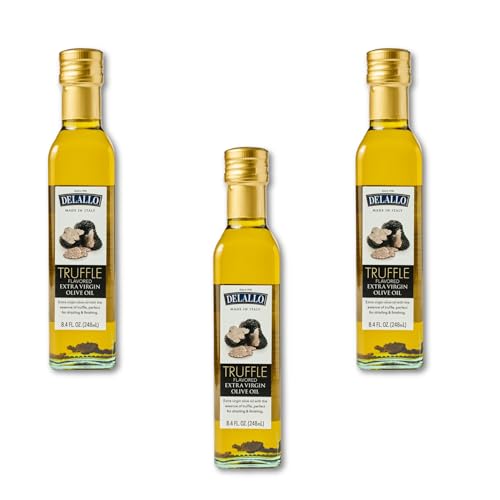
5. DeLallo Truffle Oil — Best Value 3-Pack
DeLallo is a well-known Italian food brand with a strong presence in American kitchens, and their truffle oil reflects the same commitment to quality that carries through their pasta and olive oil lines. This listing comes as a 3-pack of 8.4 oz bottles, making it the most economical choice on a per-ounce basis for anyone who uses truffle oil regularly. It's made in Italy with extra virgin olive oil infused with bold, earthy black truffle flavor.
The texture is notably silky, and the buttery, sweet character sets it apart slightly from the more aggressively earthy oils on this list. It's designed as a finishing oil — add it after cooking, not during, to preserve the aroma. A small drizzle over pasta, risotto, pizza, mashed potatoes, roasted vegetables, or even eggs produces an immediate flavor upgrade. The non-GMO, vegan, and gluten-free credentials make it suitable for a wide range of dietary preferences.
If you cook for a family or entertain regularly, having three bottles stocked means you won't run out mid-recipe. The cost savings over buying individual bottles is meaningful, and DeLallo's Italian production gives you confidence in the sourcing.
Pros:
- Excellent value — 3-pack significantly reduces cost per ounce
- Made in Italy with extra virgin olive oil
- Silky texture with a distinctive buttery, sweet truffle character
- Non-GMO, vegan, gluten-free
- Versatile across pasta, pizza, eggs, potatoes, and popcorn
Cons:
- Buying 3 bottles at once requires a higher upfront investment
- Black truffle flavor only — no white truffle option in this format
6. TruffleHunter Black Truffle Oil — Best Everyday Black Truffle
TruffleHunter operates on a clear mission: make gourmet-quality truffle products accessible without charging luxury boutique prices. Their Black Truffle Oil delivers on that promise. They use freshly shaved truffles infused with the highest-grade extra virgin olive oil, which puts them closer to the artisan end of the spectrum without the matching price premium you'd expect.
At 8.45 oz, you get a practical bottle size. A few drops add heavenly aroma and intense earthy flavor — TruffleHunter isn't shy about the potency of this oil. Use it as a finishing oil, build it into salad dressings, or fold it into marinades. It's the kind of oil that becomes a daily-use item once it's in your kitchen. The same oil that professional chefs use, available without a professional food service account required.
TruffleHunter's commitment to accessible gourmet ingredients is similar to what brands like premium sunflower oil brands do for everyday cooking oils — quality ingredients at a price that doesn't require a special occasion to justify. This is a solid everyday choice for black truffle lovers.
Pros:
- Freshly shaved truffles in highest-grade extra virgin olive oil
- Chef-quality product at an accessible price point
- Potent aroma — a few drops make a noticeable difference
- 8.45 oz bottle offers good value
Cons:
- Brand recognition is lower than La Tourangelle or Urbani
- Intense flavor means you need to use it carefully to avoid overpowering lighter dishes
7. La Rustichella White Truffle Olive Oil — Best Large Bottle
If volume is your priority, La Rustichella's 25.36 fl oz (750 ml) bottle is the largest offering on this list — and it's 100% made in Italy with a notable 5% white truffle concentration using Tuber Albidum Pico. That concentration level is meaningfully higher than many competitors who use vague "truffle infusion" language without specifying how much actual truffle is present.
The aroma is described as a surprising balance of summer scents, which sets this apart from the more aggressively earthy profiles you find in some black truffle oils. It's sophisticated and aromatic without being overpowering. La Rustichella recommends it for crostini, bruschetta, savory pies, pasta, red meats, game, and fish — both roasted and boiled — which gives you a clear picture of how versatile this oil is in practice.
The vegan, gluten-free, and cholesterol-free credentials cover most dietary bases. For restaurants, caterers, or households that go through truffle oil quickly, the 750 ml format provides exceptional value without sacrificing quality. It's a pantry investment that pays off over many meals. According to Wikipedia's overview of truffles, white truffles (Tuber magnatum) from Italy are among the most prized in the world — La Rustichella's sourcing aligns directly with that tradition.
Pros:
- Large 750 ml bottle — best value for high-frequency users
- Transparent 5% white truffle concentration — no vague labeling
- 100% made in Italy with authentic sourcing
- Vegan, gluten-free, cholesterol-free
- Elegant, balanced aroma that works across a wide dish range
Cons:
- Large bottle requires proper storage to maintain freshness after opening
- White truffle flavor only — not a black truffle option
Key Features to Consider When Choosing Truffle Oil
Real Truffle vs. Synthetic Aroma
This is the single most important distinction you'll encounter when shopping for truffle oil. Most budget truffle oils — and even some mid-range ones — use a synthetic compound called 2,4-dithiapentane to replicate the truffle aroma. It's not inherently dangerous, but it tends to produce an overpowering, one-note chemical smell that experienced cooks often find off-putting.
Oils made with actual truffle pieces or authentic truffle infusions have more complexity, nuance, and a more realistic aroma. When reading product labels, look for:
- Explicit mention of real truffle pieces or natural truffle extract
- Specific truffle species names (e.g., Tuber albidum, Tuber melanosporum)
- Country of origin for the truffles themselves
- Transparent truffle concentration percentages (like La Rustichella's 5%)
If a label says only "truffle flavor" without specifying the source, it's almost certainly synthetic.
White Truffle Oil vs. Black Truffle Oil
Choosing between white and black truffle oil comes down to what you're cooking. They're meaningfully different in character:
- White truffle oil — brighter, more floral, subtler. Best for delicate dishes: white pizza, risotto, fresh pasta, fish, soft-scrambled eggs, and salads.
- Black truffle oil — bolder, earthier, more robust. Best for hearty dishes: red meats, tomato-based pastas, roasted mushrooms, potatoes, and popcorn.
Many food enthusiasts keep one of each. If you're only buying one, think about what you cook most often and match accordingly.
Base Oil Quality
The base oil matters more than most shoppers realize. Extra virgin olive oil (EVOO) is the gold standard — it adds its own mild fruitiness that complements truffle's earthiness. Some brands use lighter, neutral olive oils to let the truffle character dominate without interference. Both approaches are valid; it depends on whether you want the olive oil character as part of the flavor or prefer pure truffle focus.
Avoid truffle oils based on cheap seed oils (canola, soybean) unless cost is your only consideration. The base oil is half the product — it deserves attention.
Bottle Size and Storage
Truffle oil degrades over time after opening, especially when exposed to light and heat. Consider:
- Smaller bottles (5–8 oz) — better if you use truffle oil occasionally, since you'll finish them while the oil is still at peak quality
- Larger bottles (25 oz+) — better for restaurants, caterers, or frequent home users who will go through the product within 2–3 months of opening
- Store in a cool, dark place — a pantry or cabinet away from the stove is ideal
- Refrigeration can cause cloudiness; bring to room temperature before using
Common Questions
What is truffle oil actually made from?
Most commercially available truffle oils are made from a base oil — typically olive oil — infused with either real truffle pieces, natural truffle extract, or a synthetic aroma compound called 2,4-dithiapentane. Premium brands use authentic truffle content and specify the truffle species on the label. Budget options almost always use the synthetic compound, which produces a more aggressive, one-dimensional aroma than real truffle oil.
Should truffle oil be used for cooking or as a finishing oil?
Truffle oil should be used as a finishing oil, not a cooking oil. Heat destroys the volatile aromatic compounds that give truffle oil its distinctive scent and flavor. Always add truffle oil after cooking — drizzle it over plated dishes, stir it in at the last moment, or use it in cold preparations like dressings and dips. Applying it during high-heat cooking wastes the product and produces a flat, sometimes unpleasant flavor.
How long does truffle oil last after opening?
Most truffle oils maintain their best quality for 6 to 12 months unopened. Once opened, plan to use the oil within 2 to 3 months for optimal aroma and flavor. Store it in a cool, dark location away from heat sources. Refrigeration can extend shelf life slightly but may cause the oil to go cloudy — this is harmless and reverses at room temperature. Always check for off smells or rancidity before using.
What is the difference between white and black truffle oil?
White truffle oil has a brighter, more floral, and subtler aroma — it pairs best with delicate dishes like white pizza, fish, fresh pasta, and eggs. Black truffle oil is earthier, bolder, and more robust, making it a better match for red meats, tomato-based sauces, roasted mushrooms, and heartier dishes. Both types are finishing oils and should not be used for cooking at high heat.
How much truffle oil should I use per dish?
A little goes a long way. For most dishes, start with just a few drops to half a teaspoon and adjust from there. Truffle oil is intensely aromatic, and using too much can overwhelm a dish and produce a harsh, synthetic-smelling result even with high-quality oils. Drizzle lightly and taste as you go. It's much easier to add more than to correct an over-truffled dish.
Is truffle oil healthy?
Truffle oil made with extra virgin olive oil carries the same general health benefits as EVOO — it contains monounsaturated fats, antioxidants, and anti-inflammatory compounds. Truffles themselves contain protein, fiber, and various minerals. However, truffle oil is still a fat and should be used in moderation as part of a balanced diet. Oils made with synthetic aroma compounds are nutritionally similar to their base oil, since the synthetic additive is present in negligible quantities.
Buy on Walmart
- La Tourangelle, White Truffle Oil, Complex Gourmet Earthy Fl — Walmart Link
- Urbani White Truffle Oil 8.45 Fl Oz – Olive Oil Infused with — Walmart Link
- TRUFF White Truffle Oil - White Truffle Infused Olive Oil - — Walmart Link
- TRUFF Black Truffle Oil - Black Truffle Infused Olive Oil - — Walmart Link
- DeLallo Truffle Oil, Made in Italy with Extra Virgin Olive O — Walmart Link
- TruffleHunter - Black Truffle Oil - Extra Virgin Olive Oil f — Walmart Link
- La Rustichella - White Truffle Olive Oil 25.36 fl oz (750 ml — Walmart Link
Buy on eBay
- La Tourangelle, White Truffle Oil, Complex Gourmet Earthy Fl — eBay Link
- Urbani White Truffle Oil 8.45 Fl Oz – Olive Oil Infused with — eBay Link
- TRUFF White Truffle Oil - White Truffle Infused Olive Oil - — eBay Link
- TRUFF Black Truffle Oil - Black Truffle Infused Olive Oil - — eBay Link
- DeLallo Truffle Oil, Made in Italy with Extra Virgin Olive O — eBay Link
- TruffleHunter - Black Truffle Oil - Extra Virgin Olive Oil f — eBay Link
- La Rustichella - White Truffle Olive Oil 25.36 fl oz (750 ml — eBay Link
Key Takeaways
- La Tourangelle is the go-to for a reliable, complex white truffle finishing oil that works beautifully across a wide range of everyday dishes.
- TRUFF's white and black truffle oils are the premium pick for gift-giving or when you want a brand with strong visual identity and real truffle content at a higher price point.
- DeLallo's 3-pack offers the best cost-per-ounce value for households and entertainers who use truffle oil regularly and want Italian-sourced quality in bulk.
- La Rustichella's 750 ml bottle is the standout choice for professional-volume users who want transparent truffle concentration (5%) and authentic Italian production in a large format.


About Touseef Shaikh
Touseef Shaikh is a food writer and grocery researcher with years of experience evaluating grocery products for nutritional quality, ingredient transparency, and everyday value. His research-driven approach to food product reviews covers pantry staples, snacks, beverages, fresh produce, and organic alternatives — with a focus on helping shoppers make better decisions at the grocery store without spending more than they need to. At GroceriesReview, he covers food and grocery product reviews, buying guides, and meal planning resources.
You can get FREE Gifts. Or latest Free phones here.
Disable Ad block to reveal all the info. Once done, hit a button below