7 Best Brands of Soy Milk and Their Benefits
by Touseef Shaikh
Soy milk commands roughly 40 percent of the entire U.S. plant-based milk market — a share that no other non-dairy alternative has managed to dethrone since the category first gained mainstream traction in the 1990s. The global soy milk market was valued at more than $11 billion in 2023 and analysts expect steady expansion well into 2026, driven by rising rates of lactose intolerance, growing interest in plant-based diets, and decades of nutritional research validating soy's protein profile. For shoppers standing in the dairy aisle — or browsing online — the sheer number of brands, formats, and formulations can make a straightforward purchase feel unnecessarily complicated.
This guide cuts through the noise. Each product reviewed below was evaluated on protein content, ingredient quality, shelf-stability, taste profile, and overall value. Whether a buyer is pouring it over a bowl from our list of the 10 best healthy granola cereals, blending it into a morning smoothie, or substituting it in baked goods like the recipes featured in our vegan brownie mix guide, the right soy milk makes a meaningful difference. According to the U.S. Food and Drug Administration, soy qualifies as one of only a handful of plant foods that delivers all essential amino acids, making it a genuinely complete protein source. That distinction separates it from most other plant-based milks on the market.

The seven brands profiled here span a range of formats — refrigerated half-gallons, shelf-stable carton packs, and even an instant powder — so buyers can find an option suited to their storage situation, budget, and daily routine. Prices, availability, and formulations referenced throughout reflect conditions in 2026. For anyone exploring the broader universe of plant-based alternatives, the product reviews section covers dozens of comparable categories. Each product below is linked directly to Amazon for current pricing.
Contents
- Best Choices for 2026
- Full Product Breakdowns
- Silk Soymilk Original — Best Everyday Refrigerated Option
- Silk Shelf-Stable Organic Unsweetened — Best for Clean-Label Shoppers
- Edensoy Unsweetened Organic — Best for Highest Protein
- Silk Shelf-Stable Original — Best Pantry Staple
- Pacific Foods Original Ultra Soy — Best for Cooking and Baking
- Vitasoy Original — Best Single-Serve Format
- NOW Foods Organic Soy Milk Powder — Best Travel-Ready Option
- Choosing the Right Soy Milk: A Buying Guide
- Questions Answered
- Next Steps
Best Choices for 2026
- #PreviewProductRating
- Bestseller No. 1
 Rating:

- Bestseller No. 2
 Rating:
 - Bestseller No. 3
 Rating:
 - Bestseller No. 4
 Rating:
 - Bestseller No. 5
 Rating:
 - Bestseller No. 6
 Rating:
 - Bestseller No. 7
 Rating:

Full Product Breakdowns

1. Silk Soymilk, Original — Best Everyday Refrigerated Option
Silk's Original Soymilk in the 64-fluid-ounce refrigerated carton has held a position as one of the category's top sellers for years, and the reasons are not hard to identify. Each serving delivers 8 grams of complete plant-based protein — equivalent to what many buyers expect from a glass of cow's milk — along with 50 percent more calcium per serving than standard dairy milk, according to the brand's own labeling verified against USDA nutrient data. The soybeans are Non-GMO Project Verified, an independent certification that has become a baseline expectation among health-conscious shoppers in 2026.
The flavor profile leans slightly sweet without added sugar, a characteristic that comes from the natural starches in whole harvested soybeans. Most users find it versatile enough to drink cold by the glass, blend into smoothies, or pour over cereal without the taste becoming overpowering. The refrigerated format means it integrates naturally into a household's existing dairy rotation, though it requires consistent cold storage and carries a shorter open shelf life than aseptic alternatives. Buyers who go through a half-gallon per week will find the format efficient; those with smaller households may want to consider the shelf-stable versions reviewed below.
Silk's manufacturing is certified dairy-free, vegan, and kosher, and the product contains no carrageenan — an additive that some consumers have flagged for potential digestive sensitivity. At the per-ounce price point typical for refrigerated plant milks, Silk Original sits in the mid-range, making it neither the budget option nor the premium choice.
Pros:
- 8g complete plant protein per serving with all essential amino acids
- 50% more calcium than dairy milk per serving
- Non-GMO Project Verified; no carrageenan, gluten, or artificial flavors
Cons:
- Requires refrigeration; shorter usable window once opened
- Slightly sweet flavor may not suit all culinary applications

2. Silk Shelf-Stable Organic Soy Milk, Unsweetened — Best for Clean-Label Shoppers
For buyers who prioritize both organic certification and the convenience of non-refrigerated storage, Silk's Shelf-Stable Organic Unsweetened Soymilk — sold in a six-pack of 32-ounce cartons — addresses both demands simultaneously. The product carries USDA Organic certification alongside Non-GMO Project Verification, positioning it at the cleaner end of the mainstream soy milk spectrum. The ingredient list is deliberately minimal: no added sugar, no carrageenan, no gluten, no egg, no peanut, and no MSG.
The unsweetened formulation makes it notably more adaptable for culinary use than sweetened alternatives. Buyers who use plant milk in savory sauces, coffee, or baking report that the neutral flavor does not compete with other ingredients. The shelf-stable packaging — a Swedish aseptic carton system — extends unrefrigerated shelf life to several months, which allows bulk purchasing and pantry stocking without waste concerns. This format is particularly practical for households that do not use plant milk daily or that want a reliable backup supply.
Because it contains no added sugar, the flavor profile is noticeably more neutral and slightly beany compared to the sweetened original. Buyers new to unsweetened soy milk may need an adjustment period, particularly if they are accustomed to the slightly sweet taste of conventional dairy. The six-pack format also represents a meaningful upfront cost, though the per-ounce price generally compares favorably to single-carton purchases.
Pros:
- USDA Organic certified with Non-GMO Project Verification
- No added sugar, carrageenan, gluten, egg, peanut, or MSG
- Shelf-stable packaging eliminates refrigeration until opened
Cons:
- Beany flavor profile requires adjustment for some first-time buyers
- Six-pack format is a significant upfront purchase
3. Edensoy Unsweetened Eden Organic Soymilk — Best for Highest Protein
Edensoy occupies a distinct niche among soy milk brands: it is consistently cited as delivering the highest protein content in the category at 12 grams per serving, a figure that surpasses most competitors by four grams or more. The brand sources non-GMO verified organic soybeans and uses only reverse osmosis purified well water in production — a process choice that reflects a manufacturing philosophy centered on ingredient purity rather than cost optimization. The six-pack of 32-ounce cartons is sold shelf-stable in Swedish aseptic packaging that requires no refrigeration until opened.
The flavor is described by frequent buyers as rich and creamy relative to other unsweetened soy milks, which makes it suitable for a wide range of applications: cereal, smoothies, coffee creamer, savory recipes, baking, and even yogurt-making. The higher protein density means each carton delivers more nutritional value per fluid ounce than many mainstream alternatives, a meaningful consideration for buyers using soy milk as a primary protein source or as a supplement to a plant-based diet. Eden Foods, the parent company, has maintained a consistently conservative approach to additives and certifications since the brand's founding.
The trade-off for this nutritional profile is a taste that some buyers describe as more intensely soy-forward than sweeter or more processed alternatives. The plain unsweetened flavor is authentic and unmasked. Buyers who enjoy the natural taste of soybeans tend to rate it highly; those seeking a mild, neutral base for flavored beverages may find it less suited to their preferences. The six-pack format also means the per-carton price is bundled into a larger order, which works well for regular consumers but less so for casual or infrequent buyers.
Pros:
- Industry-leading 12g complete protein per serving
- Non-GMO verified organic soybeans; reverse osmosis purified water only
- Shelf-stable aseptic packaging; rich, creamy texture for culinary use
Cons:
- Strong, authentic soy flavor may not appeal to all palates
- Six-pack minimum purchase required; higher per-unit cost
4. Silk Shelf-Stable Soy Milk, Original — Best Pantry Staple
The shelf-stable version of Silk's Original Soymilk brings the brand's familiar flavor profile into a non-refrigerated format, making it a practical choice for pantry stocking, emergency preparedness, or households that prefer to buy in bulk. Sold in a six-pack of 32-ounce cartons, it carries the same Non-GMO Project Verification as the refrigerated half-gallon and maintains a commitment to a clean ingredient deck: no carrageenan, no gluten, no egg, no peanut, and no MSG. The flavor is lightly sweet and creamy — the same profile that has made the Silk Original line a familiar name in plant-based beverages.
Where this product diverges from its refrigerated sibling is in convenience. The aseptic cartons can be stored at room temperature for months and opened as needed, which suits buyers who do not want to commit to finishing a half-gallon before it turns. The 32-ounce individual carton size is also well-matched to households where soy milk is used occasionally rather than daily. Each carton delivers 8 grams of protein per serving and is fortified with vitamins A, D, B12, and riboflavin, aligning closely with the nutritional profile expected from a conventional dairy milk substitute.
The flavor difference between the shelf-stable and refrigerated versions is subtle but detectable to some buyers — the heat treatment involved in aseptic packaging can slightly alter the taste of soy proteins, resulting in a flavor that some describe as marginally cooked compared to cold-processed alternatives. For most culinary applications, including cereal, coffee, and baking, this distinction is unlikely to affect the outcome. For buyers who drink soy milk cold and unaccompanied, a taste comparison between the two Silk formats is worth considering.
Pros:
- Shelf-stable pantry format; no refrigeration until opened
- Familiar Silk Original flavor in a flexible six-pack carton size
- Clean label: no carrageenan, gluten, egg, peanut, or MSG
Cons:
- Aseptic processing may create a slightly cooked taste vs. refrigerated version
- No organic certification (unlike the organic shelf-stable variant)
5. Pacific Foods Original Ultra Soy Milk — Best for Cooking and Baking
Pacific Foods has built its reputation on simple, minimally processed ingredients, and the Original Ultra Soy Milk reflects that identity. Sold in single 32-ounce cartons, the product is made with soybeans and formulated to deliver a creamy texture alongside essential minerals and vitamins. The brand markets it explicitly as a multi-use beverage: suitable for drinking by the glass, blending into smoothies, swapping for dairy milk in baking, or creating creamy sauces. That versatility claim holds up in practice — the flavor is mild and slightly sweet, with a texture that integrates cleanly into both hot and cold applications.
Pacific Foods is owned by Campbell Soup Company and operates within a supply chain that emphasizes clean sourcing. The Ultra Soy line is lactose-free and dairy-free, making it an appropriate option for buyers managing lactose intolerance. For those who explore plant-based milk substitutes across different recipe categories, Pacific Foods soy milk offers one of the more neutral profiles available in the mainstream market, which reduces the risk of flavor interference in complex recipes. The 32-ounce single-carton format is also more accessible for first-time buyers who want to evaluate the brand before committing to a multi-pack.
Buyers who cook frequently will appreciate how the protein and fat content of this soy milk behaves under heat — it resists curdling better than many lower-protein alternatives and creates a smooth consistency in cream-based sauces. The single-carton retail format is slightly less economical per ounce than the six-packs reviewed elsewhere, but the accessibility and versatility justify the positioning for buyers who prioritize culinary performance.
Pros:
- Mild, neutral flavor that integrates well into savory and sweet recipes
- Creamy texture resists curdling under heat; excellent for cooking and sauces
- Lactose-free; single-carton format ideal for trial purchases
Cons:
- Single-carton format is less economical per ounce than six-pack alternatives
- Not certified organic
6. Vitasoy Original Soy Milk — Best Single-Serve Format
Vitasoy is a brand with a long international history — the company was founded in Hong Kong in 1940 — and its Original Soy Milk has been a staple in Asian markets for decades before gaining broader distribution in North America. The 8.45-fluid-ounce single-serve format, sold in a ten-pack, is purpose-built for on-the-go consumption, school lunches, office desks, or any context where a full carton is impractical. The product is Non-GMO verified, non-dairy, and explicitly suitable for vegan and vegetarian diets.
The nutritional profile emphasizes three key areas: protein, calcium, and vitamin D. The brand positions these as the foundation of the product's health credentials, and the formulation delivers adequate amounts of each per serving. The single-serve format eliminates waste and simplifies portioning — a genuine practical advantage for households with one or two soy milk consumers rather than a family consuming a full carton per week. The compact packaging also makes it easier to keep at room temperature in a bag or pantry without dedicating refrigerator space until consumption.
The flavor profile of Vitasoy Original is somewhat sweeter and lighter than the more soy-forward options like Edensoy, which makes it approachable for newer plant milk drinkers. The trade-off is that the lighter body and smaller portion size mean it is better suited as a standalone drink than as a cooking ingredient. Buyers looking for a convenient, portable soy milk for direct consumption will find this format well-matched to that need; buyers seeking a cooking or baking ingredient would be better served by one of the larger formats above.
Pros:
- Convenient 8.45 oz single-serve format; ideal for on-the-go use
- Non-GMO, non-dairy, vegan; good calcium and vitamin D content
- Approachable, slightly sweet flavor suited to first-time plant milk drinkers
Cons:
- Small format is not practical or economical for cooking and baking
- Higher per-ounce cost compared to larger carton formats
7. NOW Foods Organic Soy Milk Powder — Best Travel-Ready Option
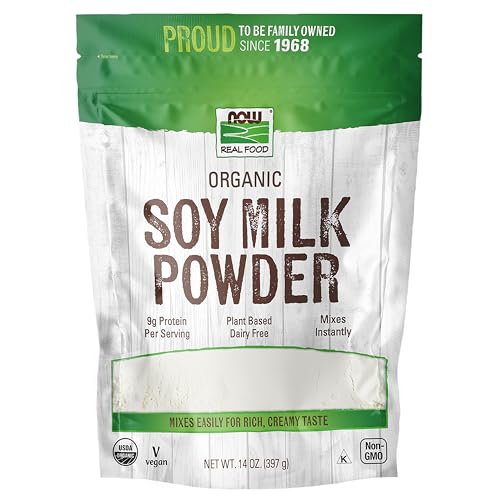
NOW Foods has long been a trusted name in the supplement and natural foods category, and the Organic Soy Milk Powder represents a logical extension into the dairy-alternative space. The 14-ounce canister of instant-mix powder offers something that no liquid carton can: complete independence from refrigeration and shelf-life constraints, making it a practical solution for travel, camping, remote work situations, and extended pantry stocking. The powder mixes instantly with water and delivers 9 grams of protein per serving — competitive with mainstream liquid alternatives.
The USDA Organic certification and plant-based, dairy-free positioning align with the brand's established audience of health-conscious buyers. The instant-mix format allows buyers to control the concentration of the resulting milk: a standard scoop ratio produces a product resembling conventional soy milk in body, while reducing water produces a thicker, creamier result suited to cooking or coffee applications. This flexibility is rarely available in pre-made liquid formats. For buyers who use soy milk in baking — including recipes from our guide to the best vegan waffle mixes — the powder format allows precise measurement without opening a full carton.
The primary limitation of powder formats is texture consistency. Buyers accustomed to the smooth mouthfeel of processed liquid soy milks may notice a slightly grainier quality with the powder, particularly if under-mixed or if the water temperature is not optimal. NOW Foods recommends warm or hot water for best results, which limits the format's convenience for cold applications unless extra blending time is applied. The 14-ounce canister yield is also finite — buyers who consume soy milk at high volume may find they go through it faster than expected compared to a six-pack of liquid cartons.
Pros:
- Fully shelf-stable powder; ideal for travel, camping, and long-term storage
- 9g protein per serving; USDA Organic certified and plant-based
- Adjustable concentration for cooking vs. drinking applications
Cons:
- Texture can be slightly grainy if under-mixed or used with cold water
- Requires preparation; not as convenient as ready-to-drink formats
Choosing the Right Soy Milk: A Buying Guide
Protein Content: What the Numbers Actually Mean
Protein content is one of the most important variables separating soy milk brands from one another — and from other plant-based milks. Most oat, almond, and rice milks deliver between 1 and 4 grams of protein per serving. Soy milk, by contrast, routinely lands at 7 to 12 grams, with Edensoy's 12-gram figure sitting at the top of the commercially available range in 2026. For buyers managing soy milk as a partial protein source — particularly those on plant-based diets who need reliable complete amino acid coverage — that per-gram difference matters over the course of a week of daily consumption. Buyers with lower protein needs, or who primarily use soy milk in coffee or cereal, may find the difference less decisive.
Sweetened vs. Unsweetened: A Taste and Usage Decision
The choice between sweetened and unsweetened soy milk is partly about taste and partly about culinary function. Sweetened versions like Silk Original work well for direct consumption, cereal, and recipes where a mild sweetness is neutral or beneficial. Unsweetened versions — including the Edensoy, Silk Organic Unsweetened, and Pacific Foods options reviewed here — are more flexible in savory applications, coffee, and baking where added sugar would interfere with the recipe. The unsweetened category has grown significantly in 2026 as more buyers seek to control added sugar intake, and most major brands now offer both variants. First-time soy milk buyers who find unsweetened versions too beany or plain may benefit from starting with a lightly sweetened option and transitioning as their palate adjusts.
Shelf-Stable vs. Refrigerated: Storage and Lifestyle Fit
The practical difference between refrigerated and shelf-stable soy milk often determines which format a buyer should choose before evaluating any other factor. Refrigerated half-gallons — like the Silk Original 64 oz — are familiar in format, typically match the price point of conventional dairy, and integrate naturally into a household's existing cold storage habits. Shelf-stable cartons require no refrigerator space until opened, allow bulk stocking, and carry a substantially longer usable shelf life measured in months rather than days. The aseptic packaging technology behind shelf-stable products is well-established and does not require preservatives. Buyers with limited refrigerator space, irregular shopping schedules, or high-volume pantry habits often find the shelf-stable format more economical and less wasteful over time.
Certifications: What to Prioritize in 2026
Three certification labels appear consistently across the top soy milk brands: Non-GMO Project Verified, USDA Organic, and vegan certification. In 2026, Non-GMO Project Verification has become near-standard among mainstream soy milk brands reviewed here, reflecting widespread consumer preference for non-genetically modified soybeans. USDA Organic certification adds a layer of assurance about pesticide use and farming practices, and commands a modest price premium — visible in the difference between Silk's standard shelf-stable and its organic variant. Vegan certification confirms no animal-derived inputs at any production stage, which matters to buyers whose dietary commitments extend beyond simply avoiding dairy. Buyers who prioritize all three certifications will find Edensoy and Silk Organic Unsweetened as the most comprehensively certified options in this roundup. For buyers who need only Non-GMO assurance, most products here qualify.
Questions Answered
Is soy milk a complete protein source?
Yes. Soy milk is one of the very few plant-based beverages that delivers all nine essential amino acids, qualifying it as a complete protein. The FDA recognizes soy protein as nutritionally equivalent to animal protein in this respect. The protein content per serving ranges from approximately 7 grams in standard commercial brands to 12 grams in high-protein formulations like Edensoy, making soy milk one of the most protein-dense plant milks available in 2026.
How does soy milk compare to dairy milk nutritionally?
Soy milk closely mirrors the macronutrient profile of cow's milk, particularly in protein, while typically delivering less saturated fat and no cholesterol. Many commercial soy milks are fortified with calcium, vitamin D, and B vitamins to match or exceed the micronutrient levels found in conventional dairy. Silk Original, for example, claims 50 percent more calcium per serving than standard dairy milk. Soy milk lacks the naturally occurring levels of vitamins A and B12 found in dairy unless those nutrients are added during fortification.
Is soy milk safe for people with soy allergies?
No. Soy is one of the eight major food allergens recognized by the FDA, and individuals with soy allergies must avoid soy milk entirely. The products reviewed here are all clearly labeled as containing soy. For buyers managing a soy allergy who still need a non-dairy, plant-based milk alternative, oat milk, almond milk, rice milk, and pea milk represent viable substitutes depending on individual allergy profiles.
Can soy milk be used as a one-to-one substitute for dairy milk in baking?
In most baking applications, soy milk functions as a reliable one-to-one substitute for cow's milk. Its protein content helps it emulsify, bind, and behave similarly to dairy in recipes involving heat. Unsweetened plain soy milk is generally the best choice for baking to avoid adding unintended sweetness to savory or precisely calibrated sweet recipes. Buyers using soy milk in recipes from categories like pancakes, waffles, or brownie mixes will typically find it performs well without further adjustment.
What does carrageenan-free mean, and why do some buyers prefer it?
Carrageenan is a thickening and stabilizing additive derived from red seaweed that has historically appeared in many plant-based milks. Some research has raised questions about its potential to cause digestive irritation in sensitive individuals, though regulatory agencies including the FDA have generally affirmed its safety at typical dietary levels. Several brands reviewed here — including Silk Original, Silk Organic Unsweetened, and Silk Shelf-Stable — explicitly label their products carrageenan-free, responding to a documented consumer preference for its removal. Buyers with a history of digestive sensitivity may want to prioritize carrageenan-free formulations.
How long does soy milk last after opening?
Refrigerated soy milk, once opened, typically remains fresh for seven to ten days when stored consistently at or below 40°F. Shelf-stable aseptic cartons have the same window after opening — they must be refrigerated after the seal is broken and treated like refrigerated milk from that point forward. Powdered soy milk like the NOW Foods option has a much longer shelf life in its sealed container, often one to two years, but once reconstituted should be consumed within the same seven-to-ten-day window. Buyers who do not consume soy milk frequently are often better served by smaller carton sizes or the powder format to minimize waste.
Buy on Walmart
- Silk Soymilk, Original, Dairy-Free, Vegan, Non-GMO Project V — Walmart Link
- Silk Shelf-Stable Organic Soy Milk, Unsweetened, Dairy-Free, — Walmart Link
- Edensoy Unsweetened Eden Organic Soymilk, Non-GMO, USA Whole — Walmart Link
- Silk Shelf-Stable Soy Milk, Original, Dairy-Free, Vegan, Non — Walmart Link
- Pacific Foods Original Ultra Soy Milk, Plant Based Milk, 32 — Walmart Link
- Vitasoy Original Soy Milk a Healthy Non GMO and Non Dairy Su — Walmart Link
- NOW Foods, Organic Soy Milk Powder, Instant Mix Dairy Altern — Walmart Link
Buy on eBay
- Silk Soymilk, Original, Dairy-Free, Vegan, Non-GMO Project V — eBay Link
- Silk Shelf-Stable Organic Soy Milk, Unsweetened, Dairy-Free, — eBay Link
- Edensoy Unsweetened Eden Organic Soymilk, Non-GMO, USA Whole — eBay Link
- Silk Shelf-Stable Soy Milk, Original, Dairy-Free, Vegan, Non — eBay Link
- Pacific Foods Original Ultra Soy Milk, Plant Based Milk, 32 — eBay Link
- Vitasoy Original Soy Milk a Healthy Non GMO and Non Dairy Su — eBay Link
- NOW Foods, Organic Soy Milk Powder, Instant Mix Dairy Altern — eBay Link
Next Steps
- Check the current price and availability of each product on Amazon using the affiliate links above — prices and stock levels for soy milk brands can shift seasonally in 2026.
- Compare the protein content per serving across the shortlisted options to identify which brand best fits specific dietary or fitness targets before purchasing.
- Order a single-carton or single-format trial of any unfamiliar brand before committing to a multi-pack, particularly for unsweetened or powder formats where taste adjustment may be needed.
- Browse the full product reviews section for related plant-based food categories, including non-dairy cooking ingredients and vegan pantry staples.
- Revisit the buying guide section above when a current brand is discontinued or reformulated — the criteria for protein content, certification, and format hold across products regardless of year.


About Touseef Shaikh
Touseef Shaikh is a food writer and grocery researcher with years of experience evaluating grocery products for nutritional quality, ingredient transparency, and everyday value. His research-driven approach to food product reviews covers pantry staples, snacks, beverages, fresh produce, and organic alternatives — with a focus on helping shoppers make better decisions at the grocery store without spending more than they need to. At GroceriesReview, he covers food and grocery product reviews, buying guides, and meal planning resources.
You can get FREE Gifts. Or latest Free phones here.
Disable Ad block to reveal all the info. Once done, hit a button below